Peer Reviewed Articles Conflict Resolution in Elementary Teams
Whether it's a dispute over who is out during a heated game on the playground or a deeper clash of values or personalities, any educator knows that disharmonize between students is normal inside and outside of the classroom.
Assisting students in resolving conflicts with peers is an of import aspect of classroom management—but solving the problem for students, rather than assisting students in resolving bug on their ain, can prevent the development of vital conflict-resolution and problem-solving skills.
Equipping children with these skills as early equally possible is crucial and central to their interpersonal success moving forrard, explains Carolyn Coffey, a preschool instructor at Educare New Orleans.
"We're education them the right way to reply to conflicts, to apply cocky-control and calm themselves," she says. "If we wait until they become to quaternary form or fifty-fifty middle schoolhouse, they've already learned in practice what they're going to exercise in gild to resolve something… and it might not exist the best way."
Many teachers like Coffey take found creative ways to aid students identify big emotions, self-regulate, and resolve interpersonal conflicts on their own. We asked educators to share what these activities look like in their classrooms.
i. How large is my problem?: To help children understand the different sizes of bug they may encounter, including how to assess conflicts with other children, teachers at Lister Elementary School in Tacoma, Washington, have students retrieve proportionally about their emotions.
Students actively discuss the kinds of issues they confront and likewise fill out a big versus little bug worksheet using existent-life examples. Unlike types of problems are written down on pieces of paper—from losing your homework to a relative existence in the infirmary—and students place them into categories based on the size.
"We talked virtually the different sizes of issues, going from 1 being the smallest up to five being something that'southward major that affects lots of people and takes a long time to solve," says fourth-grade teacher Anna Parker. "If I start throwing things and screaming because someone took my pencil, that is an unexpected behavior based on the size of that trouble."
Courtesy of Modesto City Schools
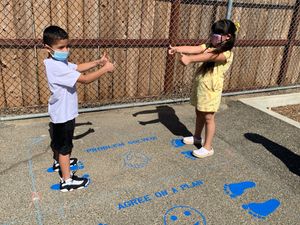
Ii students successfully completing the peace path.
2. A pathway to peace: At elementary schools in the Modesto Urban center School District, students can utilize a 6-step Peace Path to navigate their own conflicts. The actual path is generally spray-painted or paw-painted onto an asphalt physical surface with markings for where each student tin can place their feet. While continuing across from each other on opposite sides of the path, students progress through the path answering a sequence of questions aloud: What is the problem? How do you feel? How do you call up the other party feels? Collaboratively, with adult supervision, students talk over solutions and concord on a plan to move forward amicably.
"At the uncomplicated level, problems can exist anywhere," says Associate Superintendent of Educatee Back up Services Marking Herbst. "In situations where [students] need to engage in problem-solving, they will go to the Peace Path, and in some cases—depending on the students and [their familiarity] with the process—they're asked to exercise it independently."
3. Pros and cons, 2.0: Bolstering students' ability to assess their options and examine a range of alternatives—and possible consequences—leads to ameliorate, less impulsive choices while navigating conflicts.
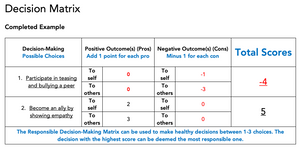
Filling out a decision matrix helps students model empathic thinking, providing them with a framework to think nearly the costs and benefits of their behavior. "Students can weigh options and evaluate the impact (pros and cons) on themselves and others using a simple point system, with positive numbers for pros and negative ones for cons," educational coach Jorge Valenzuela explains.
Courtesy of Jorge Valenzuela
For example: a student may face a decision most teasing a classmate, determining whether to be an ally to the victim or participate in the bullying. If the student can't see any positive outcomes to a course of action, it receives nil points. The educatee and then looks at possible negative outcomes for the action—like hurt feelings or punitive consequences for anyone involved—and subtracts one indicate for each.
"Subsequently tallying their numbers, the decision with the highest score tin be deemed the most responsible one," Valenzuela says. While an actual decision matrix is not always handy when on the playground, the method, once learned, can be quickly used to assess the options in a potential conflict.
four. Turning problems into opportunities: At the kickoff of course, eighth-grade English instructor Cathleen Beachboard has her students write downward a problem or event they are having on a mucilaginous note. While the strategy can be used for any type of event—academic or interpersonal—it'due south applicative to conflict management equally well. After being paired with a classmate, each pupil has i minute to talk near their problem, and their assigned partner tin brand suggestions on how to solve it.
Students participate in this action every three to four weeks to help relieve their stress and practise problem-solving. Beachboard says it also shows students that she cares well-nigh their well-being and "allows students to encounter that sometimes y'all have to go to others with bug for a new perspective."
5. Practicing conflict: Engaging students with hypothetical conflict scenarios or grouping function-playing provides them with an opportunity to practice their response to real-life conflict. They can weigh the benefits and drawbacks of each option earlier they brand a choice, says English instructor Sean Cooke, and do and so in a low-stakes environment. An additional benefit: Students proceeds an appreciation for the opinions of their peers and are pushed to exist more creative in determining how to best solve a problem they may face up.
"Past seeing others model thinking that differs from their own just that leads to a solution which satisfies their ain interests, students learn to have that in that location is more than ane mode to skin a cat, then to speak," he says.
6. A shift in perspective: Educator Neil Finney asks, "if yous were me (the teacher), how would you handle this?" to facilitate conversations between students that, he says, produce longer-lasting resolutions to conflicts.
"Seeing the issue from an outside perspective, in this case through the eyes of the instructor, can permit the student to temporarily disassociate from her ain behavior option," he says.
Asking students to talk through the thinking of another—a practise called scripted empathy— may result in an awkward silence at starting time, just Finney counsels patience, suggesting that teachers wait at least 10 seconds for students to process the question, employ their empathy, and construct a response.
7. A footling help from my friends: At Mid-Pacific Elementary School in Hawaii, fifth-class students are trained in the fine art of peer arbitration. Then, as part of the Peace Squad, they're available to help third- and fourth-graders mediate problems that arise on the school campus. If a member of the Peace Squad sees a potential disharmonize, they will approach the students and ask if they'd like to go to peer mediation. Students tin can also request peer arbitration equally long as all parties are willing to engage.
Students are escorted to a quiet surface area on campus set bated for these conversations, and nether adult supervision the resolution process begins. This can sometimes take a few minutes or spread out over the form of several days, depending on the conflict, says Chief Edna Hussey. 2 students arguing over an "unfair telephone call" in a playground game of Four Square, for case, could agree that a redo would be a unproblematic solution.
Source: https://www.edutopia.org/article/7-ways-teach-kids-manage-their-own-conflicts
0 Response to "Peer Reviewed Articles Conflict Resolution in Elementary Teams"
Post a Comment