A Prince Among Dogs and Other Stories of the Dogs We Love Book Review
Dogs (and Cats) Can Love
Neurochemical research has shown that the hormone released when people are in love is released in animals in the aforementioned intimate circumstances.
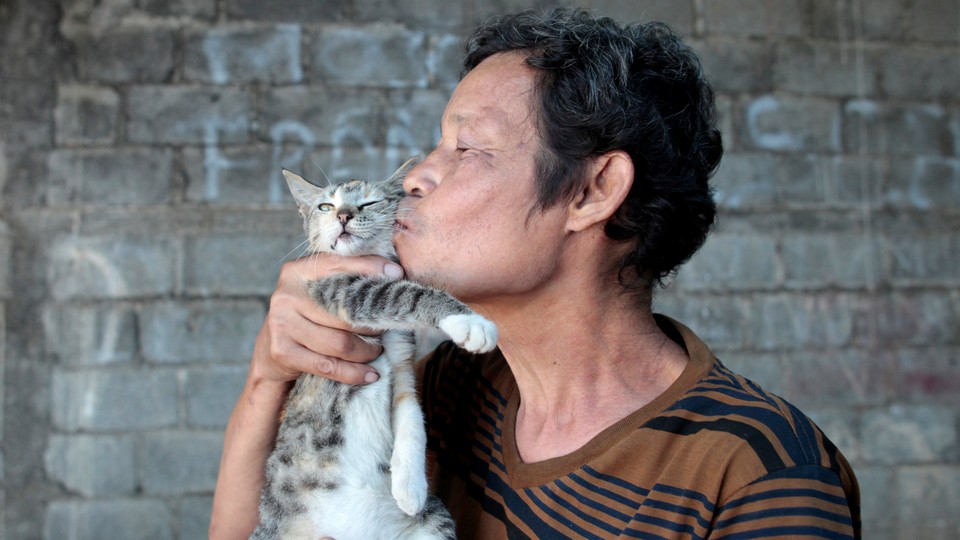
I'm not a canis familiaris person. I prefer cats. Cats make you work to accept a human relationship with them, and I like that. But I have adopted several dogs, caving in to pressure from my kids. The first was Teddy, a rottweiler-chow mix whose bushy hair was cut into a lion mane. Kids loved him, and he grew on me, too. Teddy was probably ten years when we adopted him. 5 years later he had multiple organs failing and information technology was time to put him to sleep.
When I arrived at the vet, he said I could drib him off. I was aghast. No. I needed to stay with Teddy.As the vet prepped the syringe to put him to sleep, I started sobbing. The vet gave me a couple minutes to collect myself and say adieu. I held Teddy's paw until he died. Honestly, I didn't think I was that attached.
This experience led me to undertake experiments on animal-man relations to try to understand how animals make u.s. care then much well-nigh them. Biologically, I wanted to know if pets cause the people to release oxytocin, known equally the neurochemical of love, and traditionally associated with the nurturing of one'due south offspring.
My lab at Claremont Graduate University in California pioneered the written report of the chemical basis for homo goodness. In the past decade, we have washed dozens of studies showing that the encephalon produces the chemic oxytocin when someone treats u.s.a. with kindness.
I telephone call oxytocin the "moral molecule" considering it motivates us to care for others with care and pity. Oxytocin was classically associated with uterine contractions in humans, and in rodents caring for offspring. Our studies showed that a large number of agreeable human interactions—from trusting a stranger to agree coin for you, to dancing, to meditating in a group—causes the release of oxytocin and, at least temporarily, makes us tangibly care about others, even complete strangers.
In our animal experiment, 100 participants came into my lab and nosotros obtained blood samples from them to establish their baseline physiologic states. So they went into a private room and played with a dog or true cat for fifteen minutes. Nosotros did a second claret draw after this, and and then had participants interact with each other to see how they behaved toward humans, as well. If animals caused oxytocin release in humans, information technology would explicate my surprise attachment to my dog Teddy, and perchance why people spend thousands of dollars to treat a pet medically rather than euthanize it and simply get a new brute.
Our previous studies showed that when humans engage in social activities with each other, oxytocin levels typically increment betwixt x percentage and l percent. The alter in oxytocin, measured in blood, indexes the force of the human relationship betwixt people. When your picayune daughter runs to hug you, your oxytocin could increment 100 percent. When a stranger shakes your hand, it might be five or 10 percent. If the stranger shaking your hand is attractive, oxytocin might increase 50 percent. Oxytocin is considered a reproductive hormone. It increases powerfully during sexual climax, establishing long-term bonds between romantic partners. Our experiments focus on what causes the brain to brand oxytocin and its behavioral effects.
The dog and true cat study showed that neither species consistently increased oxytocin in humans. Simply thirty percentage of participants had an increase in oxytocin after playing with an creature. We institute that ane gene predicted whether playing with a dog would increment oxytocin: the lifetime number of pets of any blazon one had endemic.
The opposite was truthful for those who interacted with cats. Greater lifetime pet buying caused oxytocin to fall linearly. Dogs are simply more "people-oriented" than cats, and previous pet ownership seems to have trained our brains to bond with them.
Nosotros also found that dogs reduced stress hormones better than cats (no surprise at that place!). When stress hormones were lower, people in the experiment trusted strangers with more of their own money. This may tell us why people who own dogs are judged equally more than trustworthy than those who don't. The man-canine bond appears to be powerful and important to both species.
Many dogs, and sometimes other mammals, exhibit some other human being-like behavior: play. I was curious if animals can form friendships with other animals and was invited to take function in a pocket-sized experiment for BBC television that would give me a chance to exam this.
As in our laboratory experiment, I wanted to see if cross-species animal play causes oxytocin synthesis. This would be biological evidence for animal friendships. That'south how I ended up in Arkansas with a goat in my lap.
At an animal refuge in Arkansas, where a large diverseness of animals interact with ane another, I obtained blood samples from a domestic mixed-breed terrier and a goat that regularly played with each other. Their play involved chasing each other, jumping towards each other, and engaging in simulated fighting (baring teeth and snarling). Both animals were young males. Nosotros so placed the dog and goat into an enclosure together and let them play. A 2nd blood sample was done after 15 minutes.
We found that the canis familiaris had a 48 percent increment in oxytocin. This shows that the domestic dog was quite fastened to the goat. The moderate modify in oxytocin suggests the dog viewed the goat equally a "friend."
More striking was the goat's reaction to the dog: It had a 210 pct increase in oxytocin. At that level of increase, within the framework of oxytocin equally the "love hormone," we essentially establish that the caprine animal might accept been in love with the dog. The only time I have seen such a surge in oxytocin in humans is when someone sees their loved ane, is romantically attracted to someone, or is shown an enormous kindness.
Charles Darwin, in his 1872 book The Expression of the Emotions in Man and Animals argued that emotions are conserved across species, including dogs, goats, and humans. That animals of different species induce oxytocin release in each other suggests that they, like the states, may be capable of love. Information technology is quite possible that Fido and Boots may feel the same way about you as you exercise about them. You lot can even call it dearest.
Source: https://www.theatlantic.com/health/archive/2014/04/does-your-dog-or-cat-actually-love-you/360784/
0 Response to "A Prince Among Dogs and Other Stories of the Dogs We Love Book Review"
Post a Comment