Bryan Cranston Talks the Art of Storytelling With Vince Gilligan
Vince Gilligan and Bryan Cranston Talk BREAKING BAD, Deciding to End the Series, the Series Finale, the Saul Goodman Spin-off, and More
Vince Gilligan and Bryan Cranston talk Breaking Bad Series Finale, the possible Saul Goodman spin-off with Bob Odenkirk, and more.
With just a handful of episodes left of the highly acclaimed AMC drama serial Breaking Bad , premiering this summer, the University of Television receiver hosted an evening to celebrate the bear witness while giving a glimpse into what fans tin can expect equally the story almost anybody's favorite meth dealer continues. Collider was there to cover and attend the event, and we've compiled the highlights of what was said during the Q&A.
During the discussion, actor Bryan Cranston talked about how he didn't quite grasp the extent of the darkness of his character's journey when he signed on, how much he's enjoyed the ride, that he got the "Br Ba" elemental chart tattooed on the inside of the band finger of his right paw to commemorate the cease of the series, which scene has resonated the most for him, how much the bear witness has changed his life and career, and just how satisfying the finale will be for fans. Show creator Vince Gilligan talked most how they decided 62 episodes was plenty to tell their story, the temptation of wanting to practise another season, how the show ended up on AMC, that the prove was originally set in the Inland Empire, their strive for authenticity, how they do the time lapse shots, that he never looks online to meet what people are saying, and whether the spin-off featuring Saul (Bob Odenkirk) might actually happen. Check out what they had to say after the jump.
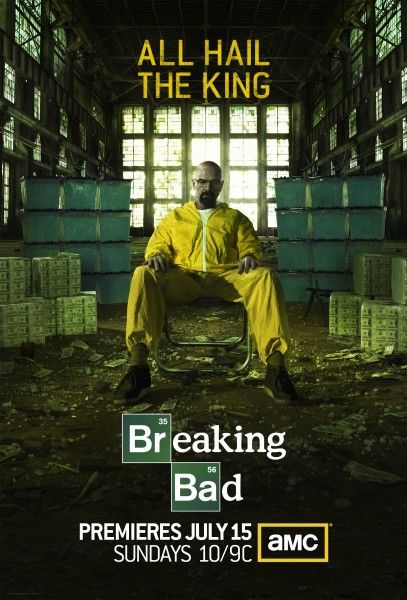
Vince, when y'all showtime started thinking nigh this show, did y'all have any inkling what the lifespan of the program would be?
VINCE GILLIGAN: I didn't know. Honest to god, I didn't think there would be a program. Scientists say that there's no way, on paper, that bumble bees should be able to fly 'crusade of the size of their wings in comparison to their body mass. If you look on paper, a middle-aged guy finds out, in the first fifteen minutes, that he'southward dying of cancer and he decides to cook crystal meth, who the fuck knew that this affair would last.
But, didn't you have some sense of the arc of the testify, beyond merely taking Walter White from Mr. Chips to Scarface? How much had you charted out, after you started to call back about the show?
GILLIGAN: Not as much equally one might think. I had half dozen wonderful writers. We did not know where we were going, for the longest time. In the early going, I thought maybe we'd have 3 seasons, in all honesty. When it looked similar we could terminal longer than that – and thank goodness for the fans and the critics and the folks that kept us on the air, all those years – nosotros eventually came to the recognition that 62 episodes, which is what we're going to end with, was about perfect, only we did not know how information technology was going to cease. Not at all.
When did you know that what happened in the last scene of that last episode would be the manner that things would go downwardly? Was the Walt Whitman volume something you lot'd planned, long in advance?
GILLIGAN: It was about 10 or 12 episodes before that. It was probably about mid-fashion through Season four that we started talking nearly, "Wouldn't it be cool if Hank Schrader (Dean Norris), this wonderful, smart DEA agent who has doggedly been after this guy that turns out to be his brother-in-police, little does he know, would, after all the hard piece of work that goes into such an investigation, literally be sitting on the toilet when he notices this volume given to Walt, that Walt probably should take not kept in the firm."
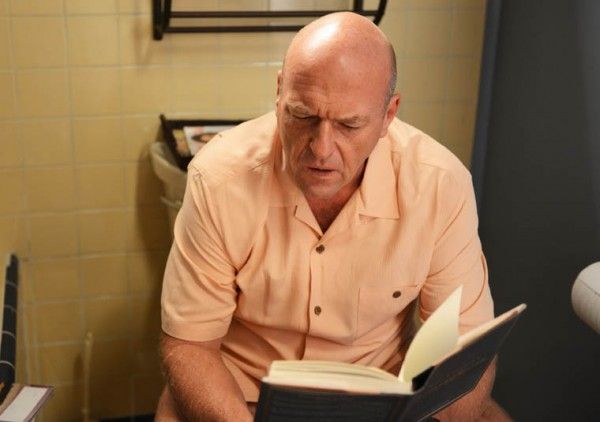
Which idea came first, the book or the shitter?
GILLIGAN: Volume beginning, and and then the toilet.
Practice yous ever think about what the legacy of this testify it going to be?
GILLIGAN: I'd be disingenuous, if I said I didn't. I watch a lot of old Idiot box shows. I lookout man a lot of Twilight Zone. That was on the air in 1959 and people are still watching information technology. Anyone who makes TV and anyone who makes movies hopes that their work outlives them. That would be my promise. I make no prognostication virtually whether or non that volition be the example, only I'd similar to believe that it would exist.
How did this show end upwards on AMC? Did you pitch it to all the networks?
GILLIGAN: The brusk answer is that AMC said yes and everyone else said no, and god bless them for information technology. It's not an unusual story that you lot pitch a testify or a movie and everyone says no except for the only ane that says yeah, and that's the only one that counts. We did, indeed, pitch the airplane pilot for Breaking Bad, all over town, and a lot of folks were really very open to it, simply too felt similar, "This is a flake dangerous. It'southward a bit risky." There's always a reason to say no. It'south piece of cake to say no. No one gets fired for saying no. They only get fired for saying yes, which is one of the pitiful things about the business concern, both with movies and television. Just AMC, luckily, said yep. 1 of my agents took it upon himself to send the script to the AMC network, and and so he called me upward and said, "Hey, I sent this thing to AMC. Everyone else has said no, so I figured, what the hell? Practise y'all know them?" And I said, "Yeah, they show Short Circuit 3, 14 times a night." That was before Mad Men, although I found out after that that was in the works, at that signal. I said, "Why don't you just send it to the Food Network, since it's a show about cooking." But, when you pull the lever of the slot machine, information technology comes up cherries, and that'southward what happened. It was perfect timing. They were in the market to create scripted programming. They had nothing to lose. They weren't as risk-adverse, perchance. When you lot're immature and hungry or up-and-coming, information technology'south easier to be gamble-adverse, and thank goodness that they wanted to exercise it.
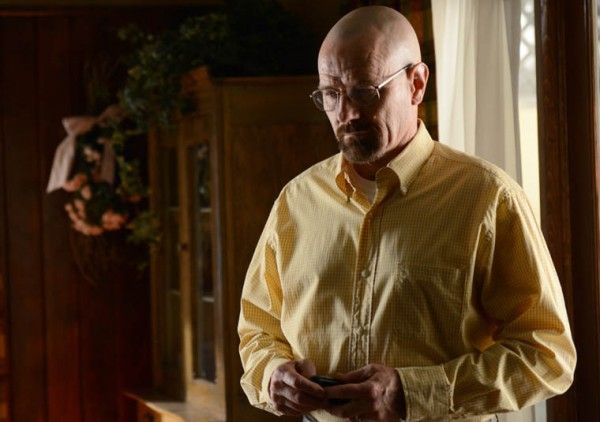
Bryan, when this bear witness began, could you e'er have imagined how dark and twisted this road would go for Walter White?
BRYAN CRANSTON: Well, he gave me that broad stroke of Mr. Chips to Scarface at our start meeting and I thought, "How Scarfacian would that be? Would it be a whitewashed Scarface? Would it be toned down a little bit?" I didn't know. He's such a fine Southern admirer. When you lot talk to him, he's engaging and polite and sweet and smart. I just didn't grasp the intensity or the darkness that lurks beneath. It's astonishing to all of u.s., who have worked with him so closely, to so observe, as we're reading the script and going, "Oh, my god!," and he's going, "Yeah, I call back information technology'southward absurd!" But I did know, when nosotros outset met, that what he was attempting to do had never been done before, in the history of television receiver. He started a graphic symbol out one way, every bit you lot become to know him a certain way, and then completely inverse that graphic symbol into someone else. To do that successfully was the gamble. We didn't know if it was going to work.
How exercise you experience about viewers who nonetheless have a lot of sympathy for your grapheme, even though he has become a monster, in many means?
CRANSTON : I've enjoyed the ride. What Vince and his writing team have been able to practise is not only instill dramatic elements in the story construction, just as well inside the audience. The audience, when they were introduced to my grapheme, was painted that way. He brilliantly laid those markers in there. He set the hook and you vicious for this guy. This guy is a good guy who's trying to do the right affair. He's got a limited amount of time, and then he makes this rash decision. We've all made rash decisions earlier, but mayhap not how this has manifested. So, you're with him. And and then, you're tested. The audition was tested at certain points of the storytelling, over the six years, and there'south going to be a turn, but that plow is so subjective. Some people say that plough happened in Season 2. Some people say it happened when they let Jane (Krysten Ritter) die. Some people volition say it happened when they let something else happen. Personally, I feel information technology happened in the very first episode, when he attempted to go someone he wasn't. Once yous do that, it a slippery slope. He lost his soul, and he allowed it to but drift away. He'southward in trouble.
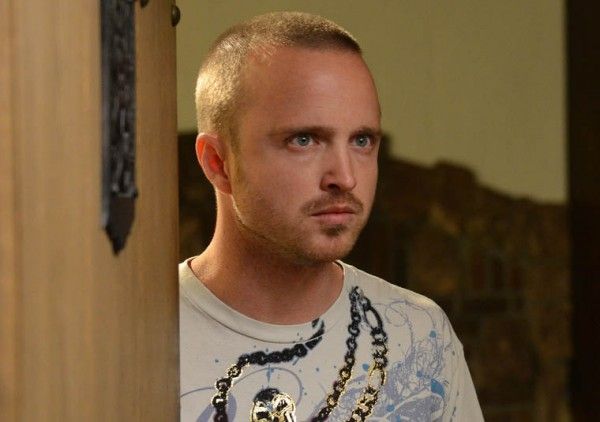
Who's Walt'due south greatest threat now? Afterward having tending of and so many of his enemies, is it Hank?
CRANSTON : It's going to exist a wonderful surprise, these concluding eight episodes, for how information technology'south resolved. I tin only say that I recollect, personally and honestly, it's going to be very satisfying for the fans. When I read the finale, I thought, "Oh, yeah! Yep!"
Vince, the thought that yous would choose to finish a evidence when it'south and then critically successful and such a large hit with its fans seems crazy. Was there a temptation to continue the show for more than seasons?
GILLIGAN: There was a temptation. At that place was a great lack of clarity, on my office, about how long this story should go and for how many seasons, and it was a very hard question to respond. I feel blessed that we had clarity and that we had the knowledge. The last thing in the world that I would want to know, in my own life, is when I'one thousand going to pass away. 1 of the all-time blessings of this show was knowing, some time around the end of Season 4, exactly how many more episodes we were going to have, which was 16 more episodes. Then, the writers and I went dorsum to the writers room and put up this big cork board that we divided into 16 equal sections and figured out exactly how much story we had left. Y'all want to parcel it out, and then that you lot end with having tied up the very last loose finish and finish the concluding fleck of plot that you hoped to achieve. You lot desire to get out everything on the field. You don't desire to get out anything lacking, but yous don't want to finish upwardly your story besides soon. You desire to time it out just right. There'due south no way you can practice that on a typical Boob tube show because Idiot box, past its very nature, is designed to be indefinite and get on forever. Information technology was a wonderful thing that they allowed us to do. Information technology was very deplorable. I'g sad right now. We wrapped up a week agone, Wednesday. That was our last day, and it was very moving. We were on location, and not on our soundstage. It was very distressing and bittersweet, but I'm very thankful to be able to say that, at no fourth dimension in the concluding few months, did I say, "Whoops, we fabricated a error. Nosotros should take gone another year." As sad as I am for this wonderful family to, in some sense, deliquesce and go to the iv winds, although hopefully we'll e'er be in touch and always be friends and piece of work together once again, and this family unit is in the process of dissolution, as we speak, all things must come to an end. I'thousand actually proud of these concluding viii episodes. I've been so worried, for so many months, that we were going to screw it up. Information technology's for you to decide, when you lot run across it when it airs, but I think my writers and the actors would agree that we left information technology all on the field.
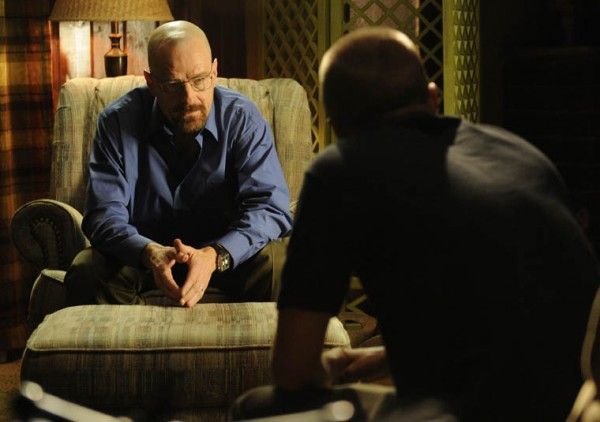
How did you marker the terminate of the evidence?
GILLIGAN: We had champagne that was chilled.
CRANSTON: Anytime in the last episode, when characters were finished with their work for that episode, we'd have a farewell and more champagne. That'due south why information technology concluded so well. And then, on the very last day, a lot of crew members were saying, "I'm going to get a tattoo." They were going to get something that said, "Br Ba," and then many of the crew members said they were going to do information technology. So, our medic on the evidence said that he was going to arrange it. It just so happened that a very talented tattoo artist in our fine art section, Richard, was going to be there and ready shop and give tattoos out. It was a very Breaking Bad thing. So I went, "I'thousand going to do that. I'yard going to go a tattoo." In my item age group, nosotros don't go tattoos. When I was a kid, anybody that had a tattoo was either in the Hell's Angels or in the Navy. Then, I decided that I was going to do information technology, and I had to figure out where to put it. It'southward the little Br Ba elemental chart, on the inside of my ring finger, on my correct paw.
Vince, this bear witness wasn't originally set in New United mexican states, right?
GILLIGAN: The original script, as I wrote it, took place in the Inland Empire. I was, and still am, friends with a DEA agent, who I've known for years. At that point, he was at the Riverside district office, so I thought I'd set it there, as a shout-out to him. And then, as luck would have it, Sony said, "What about New Mexico?" And I said, "What virtually information technology?" They said, "Well, a xxx% rebate." And y'all know what? It was one of the best things that happened to the evidence, other than hiring the wonderful cast. Albuquerque, New Mexico is a wonderful place to shoot, as is Southern California. No criminal offense to the concern here, only it was perfect for Breaking Bad.
CRANSTON : It was a happy accident for us to get to New United mexican states, merely it became a function of the fabric of the storytelling procedure. It was a grapheme, in and of itself, and information technology legitimized the endeavor that Walt and Jesse (Aaron Paul) were in.
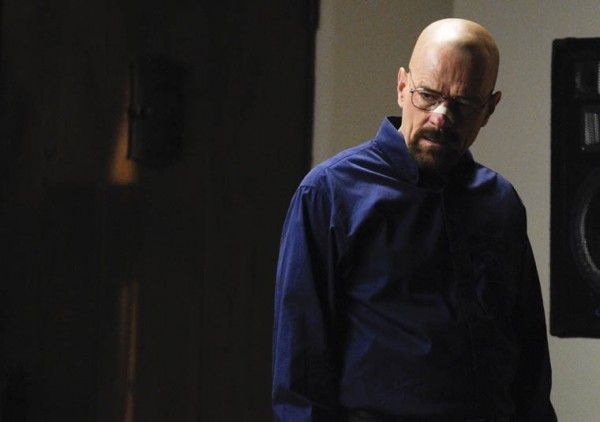
How careful take you had to exist with showing how meth is fabricated?
GILLIGAN: Nosotros strive for actuality, in every way that we tin, whether it's the oncologist dealing with Walt's cancer or the DEA. The DEA has been very helpful to us, as far as helping united states of america strive for authenticity. As far as the meth goes, we concur that to the same standard. You could cook meth with that equipment. It'south basically a brewing process, except more than complicated.
CRANSTON: Whenever we showed it, we never showed it in sequence. Nosotros always left a pace out, or did it out of society.
GILLIGAN: That was in the early days. It's a circuitous procedure. The truth of it is that we live in a mail service-Google world where you can find vi recipes for meth in 30 seconds on a search engine.
Vince, did yous plan the transitional landscape shots and the fourth dimension lapse stuff, or was that born out of necessity?
GILLIGAN: That time lapse stuff was never something I was thinking of, when I was writing the pilot. What'southward so neat nearly making tv is that it's a collaborative animal. It's created by a bang-up many hands belonging to a great many people. It was somebody's idea, at some point, to practise that. The technology now, with the digital SLRs, is such that pretty much every time lapse yous've ever seen on the testify was shot with a Canon 5D Marker Two or a 7D, or a Nikon D8, which are something you could get at Best Buy.
CRANSTON: Nosotros had a crew that would come out periodically and set upward for the angle they would want, and they'd stay all dark, shooting it.
GILLIGAN: You can shoot those on your own. They're a lot of fun to shoot. It's actually really satisfying to shoot a time lapse. And it became a visual motif. Other shows exercise it, besides. It'south a fun way to evoke the passage of time.
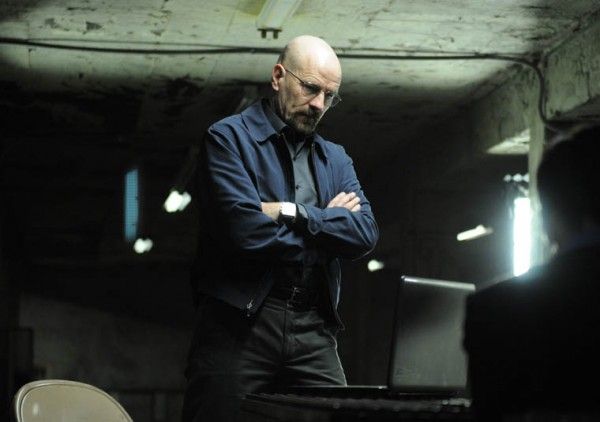
Bryan, what was your favorite scene that you lot acted in and just thought was awesome?
CRANSTON : Information technology'due south in the very last flavor coming upwards, when I take over a small-scale country. That was monumental. No. I continue going back to something that became a very personal thing for me. The scene when I sentinel Jane die resonated with me tremendously, as a father, having that type of moral struggle. He really was struggling with what he should practise and what the best motility was, and vacillating with the error of omission is what finally took him.
Do yous ever look online to encounter what people are saying nigh the testify?
GILLIGAN: I take to say that I never go on the net for anything but porn. I literally have never Googled myself.
CRANSTON : It'southward fun!
GILLIGAN: It's not because I'm jaded or that I accept an ego. Information technology's quite the opposite. It's an understanding of how neurotic I am. I know there could exist 100,000 good posts, and all that I'll remember is the 1 bad 1, and so what the hell is the indicate?
CRANSTON : At that place's more than than one, really.
GILLIGAN: And then, it'southward not out of some moral purity, on my part. Information technology'southward only understanding how weak I truly am. I've imparted that philosophy to the writers, but some of them look stuff up while some don't. Same with the editors, directors and actors. To each their ain. It wouldn't make me feel good, so I don't exercise it. I do hear things, anecdotally through the grapevine, in general, about how things are playing. Nosotros just endeavour to bulletproof the story, every bit well as we tin can. The writers are the first audience for it, and nosotros crush our heads confronting the wall until it makes sense to united states and until nosotros come upwardly with something that we like. We make sure, as much as humanly possible, that we can dot all the I's and cantankerous all the T's, and tie upwards all the loose ends. Nosotros're a tough audience, the seven of united states, because nosotros've watched a lot of TV, we've watched a lot of movies and we've read a lot of books, and we tin odor BS, a mile away. We're trying to shovel it ourselves, so we attempt to shovel as lilliputian of it equally possible.

Bryan, what'south it similar to work in and then many different mediums and genres now?
CRANSTON : Any performer would love to have the opportunity to be able to limited themselves in many different areas. If you feel confident in those areas, you would hope to have the opportunity to practice them, whether information technology'southward drama, one-act, musical, or whatever your interests are. I should say, and unabashedly so, that all these good things are happening for my career, correct now, considering of this testify. This show changed my life, both professionally and personally, and I am forever grateful to [Vince] for that.
Vince, in that location'south been talk about a possible spin-off featuring Saul (Bob Odenkirk). How real is that, and have y'all written anything yet?
GILLIGAN: I would very much similar to run into that happen. Nosotros are talking about information technology. Null is gear up in stone yet, but I can tell you, for sure, that I would love to see that happen.
CRANSTON : Are we all in information technology?!
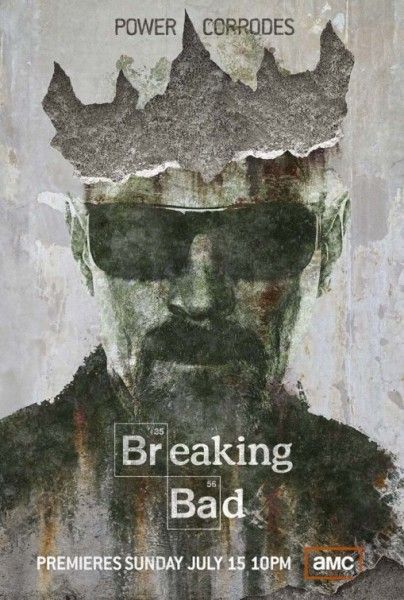
Breaking Bad returns for its final episodes this summertime on AMC.
About The Author

Source: https://collider.com/breaking-bad-series-finale-vince-gilligan-bryan-cranston-interview/
0 Response to "Bryan Cranston Talks the Art of Storytelling With Vince Gilligan"
Post a Comment